Amy Fadool, NBC Sports Philadelphia sports anchor, reporter, and host, Lara Price, Philadelphia 76ers chief operations officer, and Renee Washington, ‘14, NBC Sports anchor and ESPN reporter and analyst joined La Salle University former Men’s Basketball head coach, Fran Dunphy, ‘70, and the Business of Sports Club for a panel discussion moderated by Mike Sielski, ‘97, award-winning author and columnist.
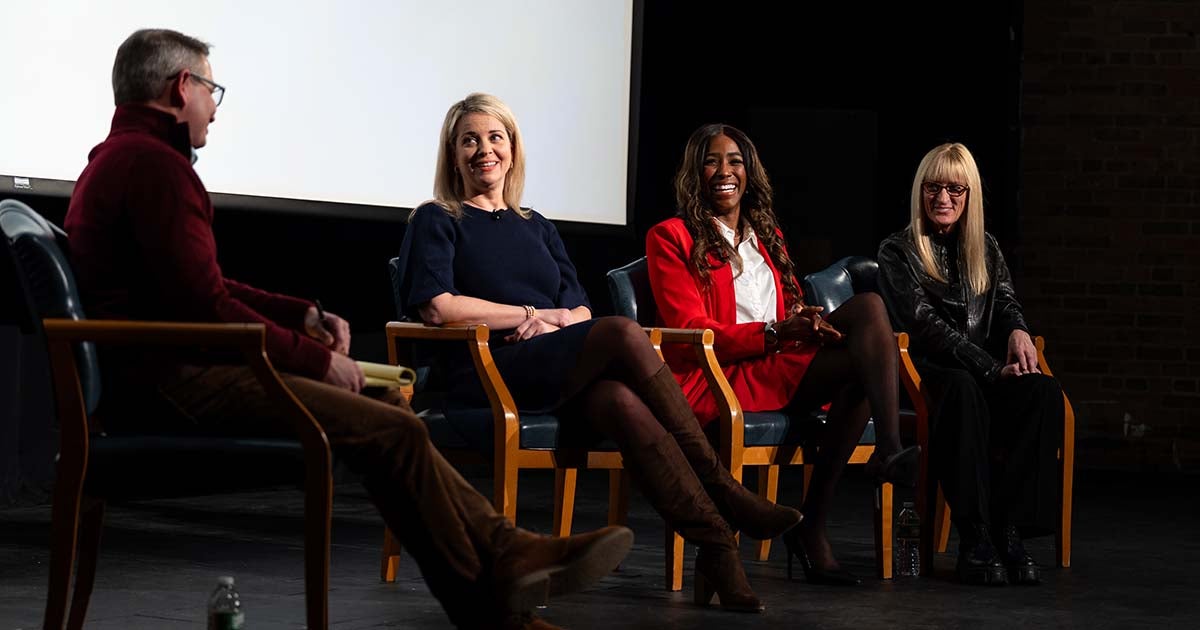
On Tuesday, March 3, former La Salle University Men’s Basketball head coach, Fran Dunphy, ‘70, and the Business of Sports Club hosted the third installment of the Voices of La Salle speaker series with a fitting all-female panel for the start of Women’s History Month.
On Tuesday, March 3, former La Salle University Men’s Basketball head coach, Fran Dunphy, ‘70, and the Business of Sports Club hosted the third installment of the Voices of La Salle speaker series with a fitting all-female panel for the start of Women’s History Month.
Dunphy introduced Amy Fadool, NBC Sports anchor, reporter, and host, Lara Price, chief operations officers of the Philadelphia 76ers, and Renee Washington, ‘14, NBC Sports anchor and ESPN reporter and analyst, for a discussion focused on authenticity, being a woman in a male-dominated field, representing your audience, and more. The conversation was moderated by Mike Sielski, ‘97, award-winning author and columnist.
Continue reading for four key takeaways from the panel discussion.
Authenticity and community building: a fabric of the city
The conversation began with the acknowledgment of sports and sports fandom being such an integral part of Philadelphia culture. Each panelist shared how building community and authenticity with their audiences are key parts of their roles.
For Price and the 76ers, it involves giving back to everyone who supports the team.
“We are a fabric of this city, and there’s a responsibility… to the community that we live, work, and play,” she said, adding that a lot of work is done by the team through foundations and community work, all in the midst of an ever-changing media landscape.
“Our community and authenticity is really important, but a lot of it comes through our players and then how we activate with them in the communities that we know we operate in,” she added later.
Fadool and Washington also see building community as a crucial part of their roles as broadcasters.
For Fadool, who quickly saw the Philadelphia market is a place where supporting its sports teams is particularly important to the fans, it’s vital to be able to back that up with knowledge of the franchises as they are today and their histories.
“How you foster that authenticity is, obviously reading is a huge, huge, part of that, and learning about your community and interacting with the people and making sure that when you present yourself, that you are as authentic as possible,” she said, adding that she is invested in the teams even when it’s not work. “When people see me out and we go to a ball game on the off night, and the Sixers are on national TV and I’m at the Sixers game, I’m at the Phillies game, it’s because I want to be there, because I’m genuinely interested in the teams, and I care about the teams as much as they do.”
Washington looks at authenticity through the lens of being a trusted voice that her constantly growing and changing audience respects and looks to for guidance and education.
She shared a story about covering curling at the Winter Olympics, a sport she was not an expert in, taking the time to learn as much as she could before being that voice.
“Community building, to me, is being authentic, taking the time to also be okay with saying I don’t know everything. I don’t know every aspect of this sport, this league, this network, but I’m going to learn,” she said. “I think for me, it’s every situation know that sometimes it’s local, sometimes national, sometimes international, how do I make sure that regardless which audience I’m speaking with, they feel like I’m a friend, that they trust and value and want to talk to more or listen to on the TV.”
Representation and being in every room
The discussion around being a woman in a male-dominated industry rightfully took up a chunk of the conversation, with some panelists noting it could be the whole session.
Fadool highlighted that the experiences she, Washington, and Price have within the industry are likely quite different from those Sielski has. The standards and expectations for women are often higher, causing them to think about things like appearance or interactions more than their male counterparts.
“You do have to be completely on point at all times and it’s nerve wracking,” she said.
Fadool provided an example of the scrutiny many women in this industry experience, like saying a name wrong which might make people think she’s not knowledgeable on the subject compared with a male broadcaster, for whom it might be considered just be a mistake. That’s part of an inherent bias viewers can have, she said.
Fadool added women in this industry often need to prove themselves to show their work is credible.
Washington talked about the fact that for women in sports, there is so often an assumption that they are only there to tick a box.
“In a sense, women in sports are still the underdog, which is wild to me to even say at this point,” she said, noting that there’s often times that she’s still the only women or person of color in the room, and she has to work harder to bring her voice and opinion to the table.
Her faith leads her to see that “I’m in every room that I’m supposed to be in. I’m there for a reason. I’m the representation.”
There’s also an element of being very intentional in her interactions with the people she’s reporting on and interviewing, as well as using her background as an athlete to back that up.
“I use very specific things that show I know what I’m talking about in sport,” she said. “You find yourself having those moments where you have to be very intentional about how you introduce yourself. I’m not just Renee Washington, a sports reporter. No, I’m a sports reporter, I’ve worked with the biggest network, you know, dropping your credibility in terms of your resume and allowing it to then speak for itself when you also follow up with the research, the prep.”
Having been in the industry for nearly 30 years, Price has seen some changes since her start.
“There wasn’t a lot of people that looked like me that I could look up to,” she said. “I really did have to rely on people like the Coach Dunphy’s that are advocating for women.”
Naively, she said, she didn’t realize there was a glass ceiling in the way for her, so she spent a lot of time just working hard and trying to fit in with the men around her. She stressed the importance of the few role models she did have at the time.
While things are different today, there is still work to be done in Price’s opinion.
“You know, it’s changed. It hasn’t changed enough, but we’re working through it,” she said.
Price finished with a call to action that everyone in the room be a voice that advocates for women in sport.
“We know sports too.”
Their experiences as women in sports has also given the three panelists insight into their audiences and how to give them what they need most.
Washington mentioned expectations still held by some audiences that men should be the ones covering men’s sports, noting that she aims to always bring versatility and expertise to her coverage.
She’s had comments from parents who have thanked her for showing up and being an example for what their children can do, something that she didn’t necessarily have enough of growing up.
“I want to ensure that every time I’m stepping on a broadcast, anything I’m doing, any stage I’m stepping on, I’m ensuring that people recognize that you too can be in this position, because at one point I didn’t think I could be here,” she said. “There’s a difference, there’s a gap; we’re bridging the gap. We’re working hard to show that women can also be knowledgeable. We know sports too.”
She highlighted that there’s a “massive change” in women now taking on more roles across the sports world, showing that they “can talk the talk too.”
Fadool talked about understanding how people want to consume their news. The rise of social media led to shorter segments where viewers wanted everything in 20 seconds or less. While there’s been some pushback against that, and longform stories are rising again, trying to bridge the gap, as well as make content she would enjoy, is important to her.
“When I think about telling a story…I think about trying to not only put my authentic personality in this and try to bring that, whether it’s humor or insider knowledge or whatever, but also make it a little bit more interesting and try to bridge the gap of all right, you’re here for, I’m probably going to get a minute and a half of your time,” she said.
Price offered insight from the business side of satisfying your audience as a sports team, giving examples of things being done by different NBA teams to cater to their audiences, no matter their level of fandom. This can include collecting data points on how broadcasts are watched, whether merchandise is bought, and what type of tickets they buy.
“All that information is so important to us, and then we have an entire plan that is automated of how we engage you based on research, of how we can keep engaging you and not turn you off by sending you way too many emails or way too many socials,” she said.
Find what makes you happy
Many of the themes that were discussed throughout the panel came back up during an audience question about work-life balance. As Fadool, Price, and Washington all previously noted being a woman in sports has challenges and often test this ideal.
Price noted it can be hard for women to achieve a true balance, as no matter what they feel that they must be working harder and doing more than their male counterparts, something that won’t change without true equality.
“That feeling is still in women, and I think it starts while we’re playing sports, like we have to go that much harder, that much further, practice that much more to compete,” she said. “And until the dynamics in the workplace change, I think it’s still always going to be that way, and, just being honest, it’s hard to balance it.”
She emphasized the importance of working with and giving yourself grace, as well as having support from those around you to help out.
Washington emphasized the importance of knowing what your limits are, figuring out where your breaking point is and knowing when to take a break, as well as the fact that you don’t have to choose between work and life, you just have to be cognizant of what it takes.
“You don’t have to choose between having a social life and having a career. You don’t have to choose between getting there and having kids and having a career. That’s a very old school mindset,” she said. “You can do both, but you can also know that doing both is going to be exhausting, regardless of what that may look like for you… Find what makes you happy, because that’s when the work life balance actually starts to make sense.”
All three panelists also acknowledged that the support they receive from their parents, families, friends, and mentors is integral to staying the course.
The post Celebrating women in the sports industry appeared first on La Salle University.





0 Commentaires