La Salle University’s Speech-Language Pathology Graduate Program prepares students for success in their external clinicals through support and a rigorous classroom education.
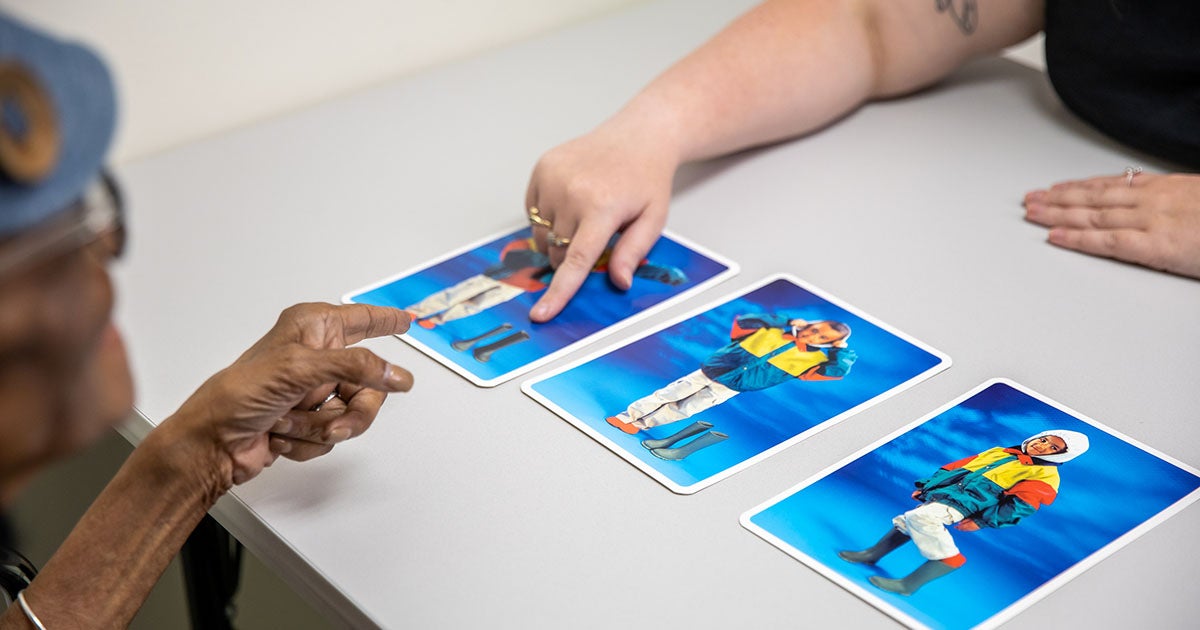
Students first work in a one-on-one environment with their clinical supervisor, seeing one client at the La Salle University Speech-Language-Hearing Community Clinics. After they’ve learned the fundamentals of treatment and assessment at the on-campus training clinic, they go on to take three external placements in varied school and medical settings across Philadelphia.
Clinicals are an integral part of the training needed to become a speech pathologists. When students see clients for the first time, La Salle University’s Speech-Language Pathology Program (SLP) ensures that they are ready to take on the next step with confidence.
“The clinicals are the basis for what we do in the field,” Maureen Costello, Ph.D., said. “Each and every clinical experience allows our students to build on their clinical foundation.”
Costello is an assistant professor and director of clinical education for La Salle’s SLP Program. She works with students to place them in clinical sites that align with their career interests.
Students first work in a one-on-one environment with their clinical supervisor, seeing one client at the La Salle University Speech-Language-Hearing Community Clinics. After they’ve learned the fundamentals of treatment and assessment at the on-campus training clinic, they go on to take three external placements, Costello explained, in varied school and medical settings across Philadelphia.
“My hope is that all students feel confident and open to learning and gaining more clinical experience and insight from each setting,” Costello said.
That hope is already being realized.
For Brittany Saulters, M.S. ‘27, her experience in the on-campus clinic set her up for success when she went to external sites, she said.
“I was both excited and nervous before my first clinical,” she said. “I had my first client in the clinic in my first semester of the program, and I was happy about that because it prepared me for my clinicals in future semesters.”
Her experience in the La Salle clinic meant she felt ready for her first day at an external school site.
“I had a feeling of what was expected. The only difference was the setting,” she said. “Each setting is completely different.”
Saulter, who earned her bachelor’s degree in psychology, became interested in working in the field after shadowing a speech therapist during her undergraduate years and seeing the difference they made in their clients’ lives.
As well as the on-campus clinic, the faculty in the program were a valuable resource for Saulters as she prepared for this step in her education, and they remained one throughout. Her professors were always available to talk to her about things that happened while she was working with clients. They also helped give her a strong foundation in the base knowledge and techniques that she would need.
“Clinicals have been so valuable in my education because I’m able to apply the material that I learn in class in an outside setting,” she said.
Saulters also credited La Salle’s program with the wide variety of external partners that they were able to connect with, noting that as well as broadening her knowledge base, it was also helpful as she worked to decide what population and setting she’d eventually like to work with.
Like Saulters, the varied clinical experiences were important to Olivia Cvengros, M.S ‘26.
“I chose La Salle specifically because I wanted to be able to have clinicals in the Philadelphia area to have the most diverse caseload experience possible,” the Northern Michigan native said.
That diverse clinical experience is vital in such a broad field that spans so many ages and populations, Cvengros said. She added that the wide range of clients that she’s worked with in clinicals has even been complimented in job interviews, something that she credited La Salle’s program for helping her achieve.
She also praised the program for how ready she felt going into those external sites–Cvengros spent time working with school districts and in acute rehabs–although she did acknowledge there were still some nerves.
“I feel like La Salle does a great job at preparing us as much as possible,” she said. “But, at the end of the day, it’s still working for the first time.”
What Explorers learn in the classroom is a big part of that, she said, as well as the fact that everyone in her cohort, and the program faculty, act as a support network.
“There’s a lot of unknown until you get in and get hands-on experience,” Cvengros said. “But we definitely had the curriculum and we had the tools, we knew how to ask for help and when to ask for help, as well as having the backing from La Salle for anything we need.”
Cvengros was drawn to speech pathology as it was, in her opinion, the perfect blend of helping people find their voice and working in a medical setting. After graduating, she started work at Henry Ford Hospital in Detroit, Mich., as the acute care clinical fellow for the 2026-2027 year. Her student clinicals helped grow her confidence as she prepared to start her career.
“Clinicals are absolutely everything,” she said. “I have a lot of admiration for the La Salle graduate program and how well they prepared us.”
-Naomi Thomas
The post Finding confidence in clinicals appeared first on La Salle University.





0 Commentaires